
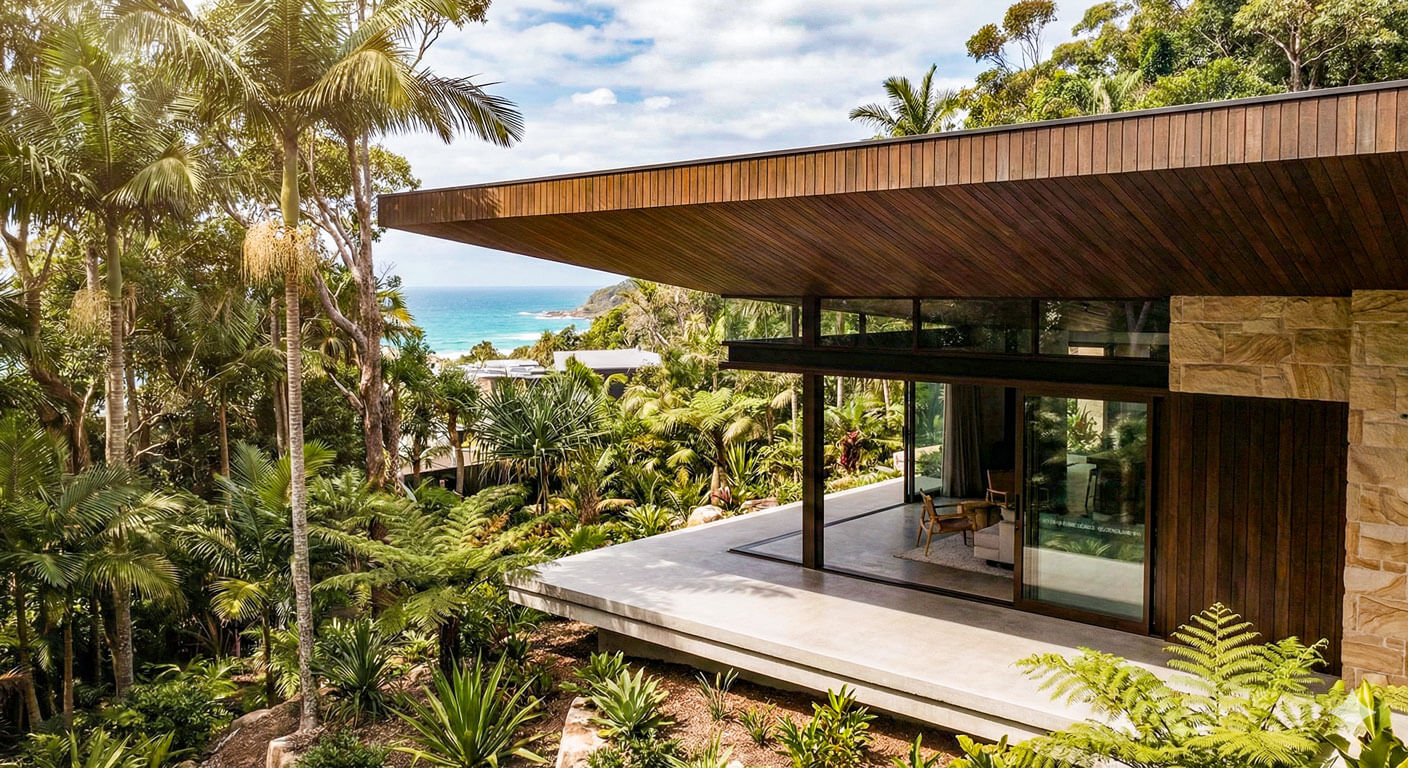
 A deep cantilevered eave offers psychological respite—a place to sit on the verge of the elements, protected by the architecture.
Defining the Threshold
True 'indoor-outdoor living' is rarely achieved by merely installing a sliding door. Rather, it is often found in the design of the threshold—the liminal space that is neither fully inside nor fully outside. This is the architectural 'edge' where the shelter of the built form meets the wildness of the landscape.
When this edge is resolved with intent, the boundary appears to dissolve. The transition softens, and the home ceases to be a container, becoming instead a vessel for the environment.
 A continuous ground plane dissolves the boundary between interior and landscape.
The Seamless Ground Plane
A primary element in softening this boundary is the floor itself. If the material shifts at the doorway, the eye registers a definitive border. To dissolve this, the ground plane is treated as a continuous surface.
When timber boards extend from the interior to the deck, visual constraints are removed. The eye is invited to travel toward the garden rather than arresting at the glazing line.
The transition softens, and the home ceases to be a container, becoming instead a vessel for the environment.
— Brett McDonald, Principal Architect
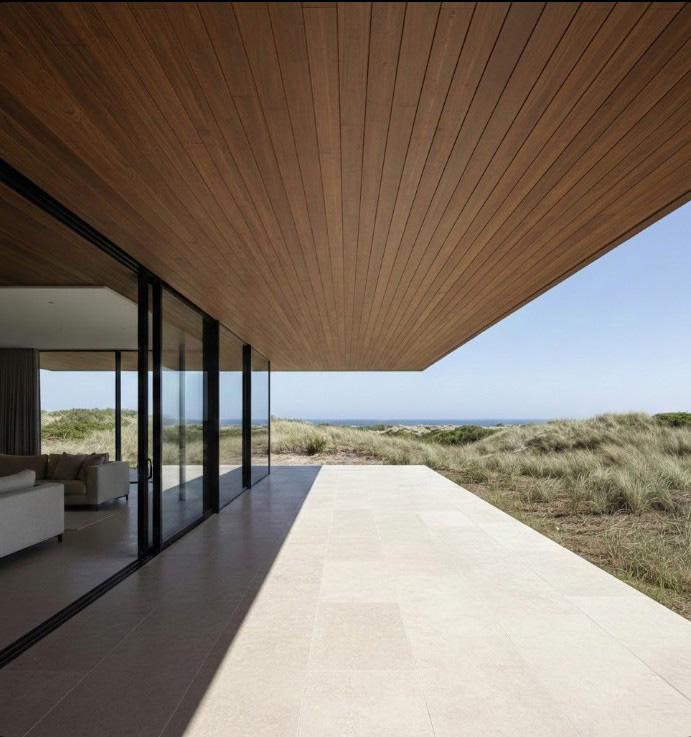 A deep timber soffit extends over a stone terrace, framing a view of coastal dunes and the ocean through large glass sliding doors.
The Protective Canopy
For a threshold to be functional, it must offer a sense of shelter. In a harsh coastal climate, the deep, cantilevered eave is a valuable architectural device.
A significant roof overhang does more than protect the glazing; it creates a zone of 'spatial compression.' This shadowed space offers a sense of psychological respite, offering a place to sit on the verge of a storm, doors wide open, experiencing the visceral scent of rain without exposure to the elements.
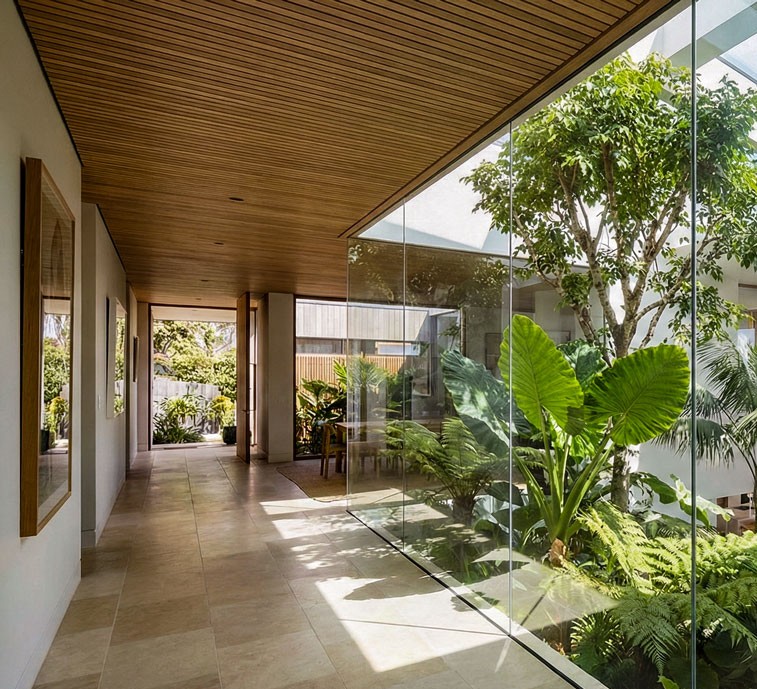 Vertical shot of a sunlit limestone hallway running alongside a glass-encased internal garden featuring a tree and lush ferns.
Landscape as Architecture
Ideally, landscaping is an integral component of the architecture, not a secondary decoration. Rather than relying solely on perimeter planting, a central glazed atrium serves as a "green lung" that breathes life into the plan. A mature tree canopy rising through the void acts as a living filter, managing light with a complexity that manufactured products cannot replicate.
By drawing greenery into the very heart of the building, the home sheds its fortress-like qualities. It invites a constant, internal engagement with the landscape.
The Space Between
Often, the most compelling room in a coastal home is neither the lounge nor the master suite. It is the space between.
It is the threshold where the cool touch of stone meets the warmth of the timber deck, and where the roofline frames the sky. By designing this transition with intent, the rigid definition of 'house' and 'garden' is softened, leaving only the experience of uninterrupted connection with the environment.
Designing for the Way You Actually Live on the Coast?
The threshold between inside and outside is where coastal homes succeed or fail. If you want a home where the floor flows unbroken to the terrace, where the eaves do the work of walls, and where the breeze moves through by design — that's the kind of architecture we practice. It begins with understanding your site.


