
 Stackable glass doors open onto a high-rise balcony with a raw concrete eave, native coastal planting, and sweeping ocean views.
The design intent must move beyond simply stacking sealed glass boxes in the sky. Instead, the focus shifts to elevating the fundamental principles of site-responsive, subtropical living.
 A raw concrete eave and seamless limestone floor frame the horizon, bringing the grounded essence of the beach house into the sky.
The Threshold in the Sky
In many high-rise developments, the balcony is treated as an extra - a windswept ledge attached to a living room. To translate the coastal lifestyle vertically, this space requires redefining as a thoughtful architectural threshold.
By integrating deep, cantilevered eaves and allowing large-format limestone tiles to flow towards the horizon past stackable glass walls, the boundary between inside and out dissolves. This creates a zone of spatial compression that offers shelter from high-altitude elements, allowing the architecture to mediate the coastal atmosphere without leaving the space feeling overly exposed.
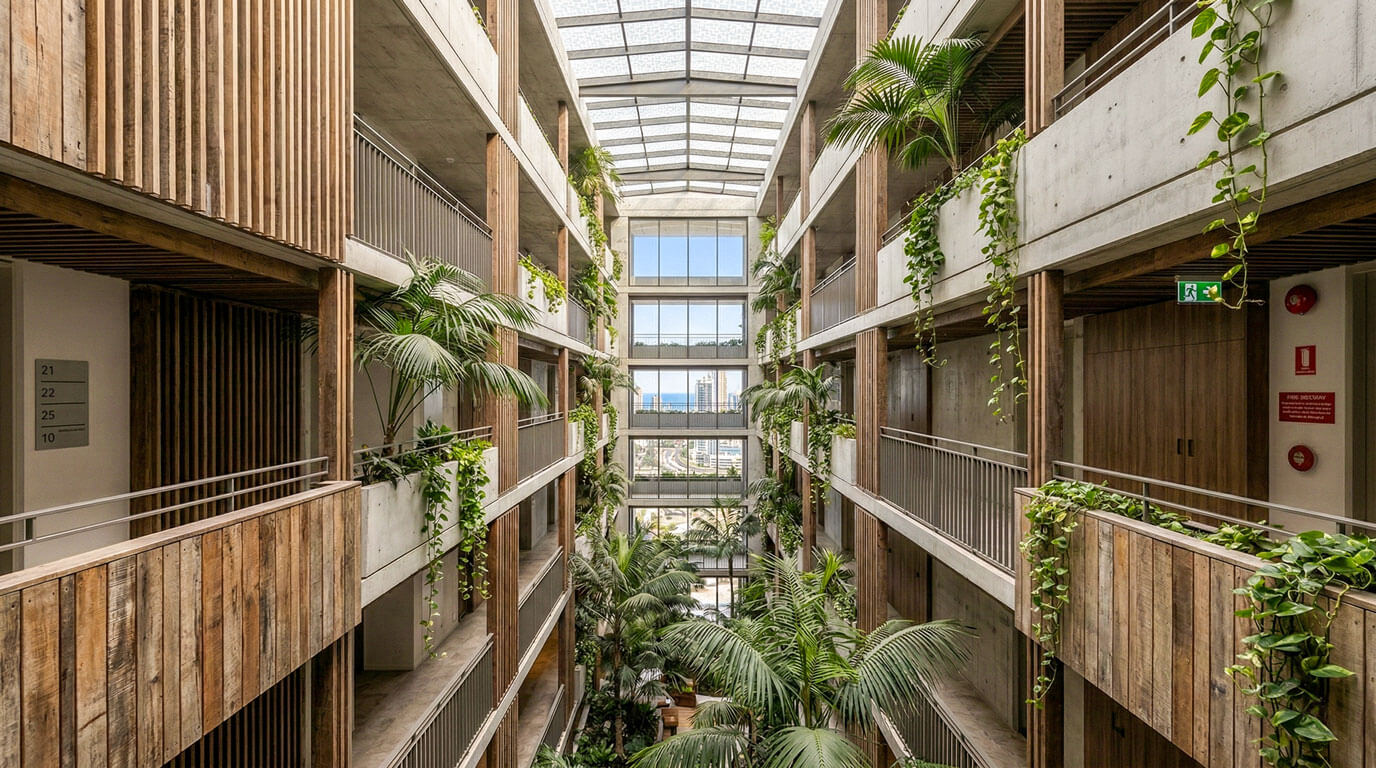 A multi-story open-air atrium featuring weathered timber battens, raw concrete corridors, and lush cascading tropical greenery beneath a filtered glass roof.
Vertical Breezeways and Internal Voids
A true coastal home breathes, and when translating this to a tower, relying solely on mechanical air conditioning severs the vital connection to the environment. A site-responsive architectural approach involves designing internal voids and multi-storey open-air atriums that serve as breathable voids for the building.
By drawing on the stack effect, these vertical breezeways help pull cool air through individual apartments. When paired with operable, high-level louvres, the design intent is to harness prevailing south-easterly winds, encouraging natural cross-ventilation and naturally reducing the reliance on artificial climate control.
 Weathered timber battens and board-marked concrete provide a necessary tactile anchor, offering a sense of permanence against the exposure of high-altitude living.
Anchoring the Soul with Tactile Materials
The higher a residence sits above the ground plane, the more disconnected it can feel; therefore, anchoring the interior with a tactile material palette provides a necessary psychological grounding.
Instead of reflective surfaces, the introduction of raw, board-marked concrete and weathered timber batten screens acts as a structural anchor. This selection communicates a quiet resilience. As sunlight tracks across these textured surfaces throughout the day, it brings the rhythmic, grounding qualities of the natural world into the living space.
Design Endurance and Curated Connection
Successful vertical architecture requires a shift in perspective that prioritises sustained liveability and ease of living. By utilising architectural elements to frame specific sightlines, the design deliberately edits out the visual noise of an increasingly compact cityscape. This distils the environment into focused, tranquil moments of canopy and water, transforming a sprawling outlook into a private, curated landscape that supports social connection and personal sanctuary.


