
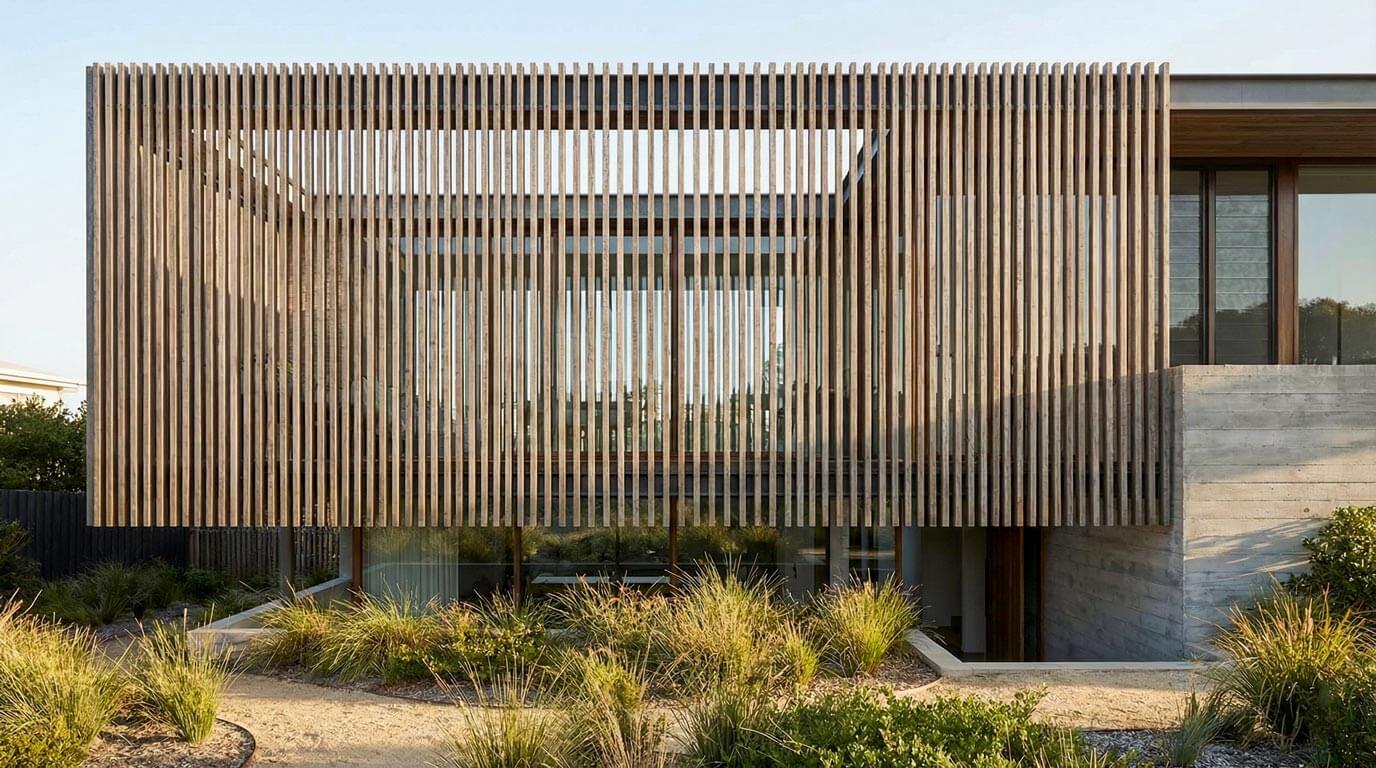
 The architectural veil. Timber battens fracture the coastal light while providing a definitive boundary from the public realm.
The Architecture of the Veil
Privacy does not require a fortress; it requires a filter. Elements such as timber battens or breeze blocks serve as a "second skin" for the home. This architectural veil allows the salt breeze to pass through and the morning light to fracture into dynamic patterns, yet it helps obscure the inhabitants from the passerby.
It creates a boundary that breathes—a definitive separation between the public street and the private sanctuary.
Privacy does not require a fortress; it requires a filter.
— Brett McDonald, Principal Architect
 Lungs of the design. Shifting the focus inward to an open-air sanctuary that draws in cool breezes and natural light.
Turning Inward
When the streetscape becomes cluttered, the most vital room in the house is often one without a roof. Functioning as the "lungs" of the design, the internal courtyard becomes an open-air sanctuary designed to encourage the flow of cool air through the floor plan via the stack effect.
By orienting the home around a private garden rather than a public road, a new focal point emerges—one that is exclusively internal and offers a profound buffer against the changing skyline of the coast.
Curating the Outlook
There is a distinct difference between a "view" and an "outlook." A view is passive; an outlook is curated.
Whether it is framing a singular gum tree through a high-level window or aligning a corridor to capture a slice of the canal, the aim is to edit the landscape.
Strategic apertures act as a visual filter, deliberately editing out the noise of telegraph poles and rooftops to distil the environment down to its purest elements: canopy, sky, and water.
 An edited landscape. Strategic apertures distil the environment down to its purest elements: canopy, sky, and water.
In a world that is increasingly loud, the role of the architect is to carve out quiet. By prioritising courtyards, screening, and curated outlooks, the focus shifts from merely constructing houses to designing the pause between the breaths.
Seeking Privacy Without Sacrificing the Coast?
Designing for seclusion on a densifying coastline is one of the most nuanced challenges in residential architecture. If your site presents this tension — neighbours closing in, but the ocean still within reach — we specialise in creating inward-looking homes that capture light, air, and calm without relying on the view.


