
 A home facing the Pacific, where refined interior living meets the first line of biological defense.
When mass-planted against the raw textures of off-form concrete or natural stone, these silver tones create a sophisticated, muted palette that feels inherently 'of the place'.
 Recognising that beauty on the coast is found in the juxtaposition of soft, shimmering foliage against architectural mass.
The Curator’s Hand: Silver and Stone
The design intent shifts from 'fighting' the environment to 'curating' it. Coastal resilience often manifests in a specific aesthetic: the silver-grey leaf. Species such as Banksia integrifolia or Leucadendron have evolved a waxy or hairy coating to deflect salt and retain moisture.
When mass-planted against the raw textures of off-form concrete or natural stone, these silver tones create a sophisticated, muted palette that feels inherently 'of the place'. This is the 'curator’s hand' - recognising that beauty on the coast is found in the juxtaposition of soft, shimmering foliage against the permanence of architectural mass.
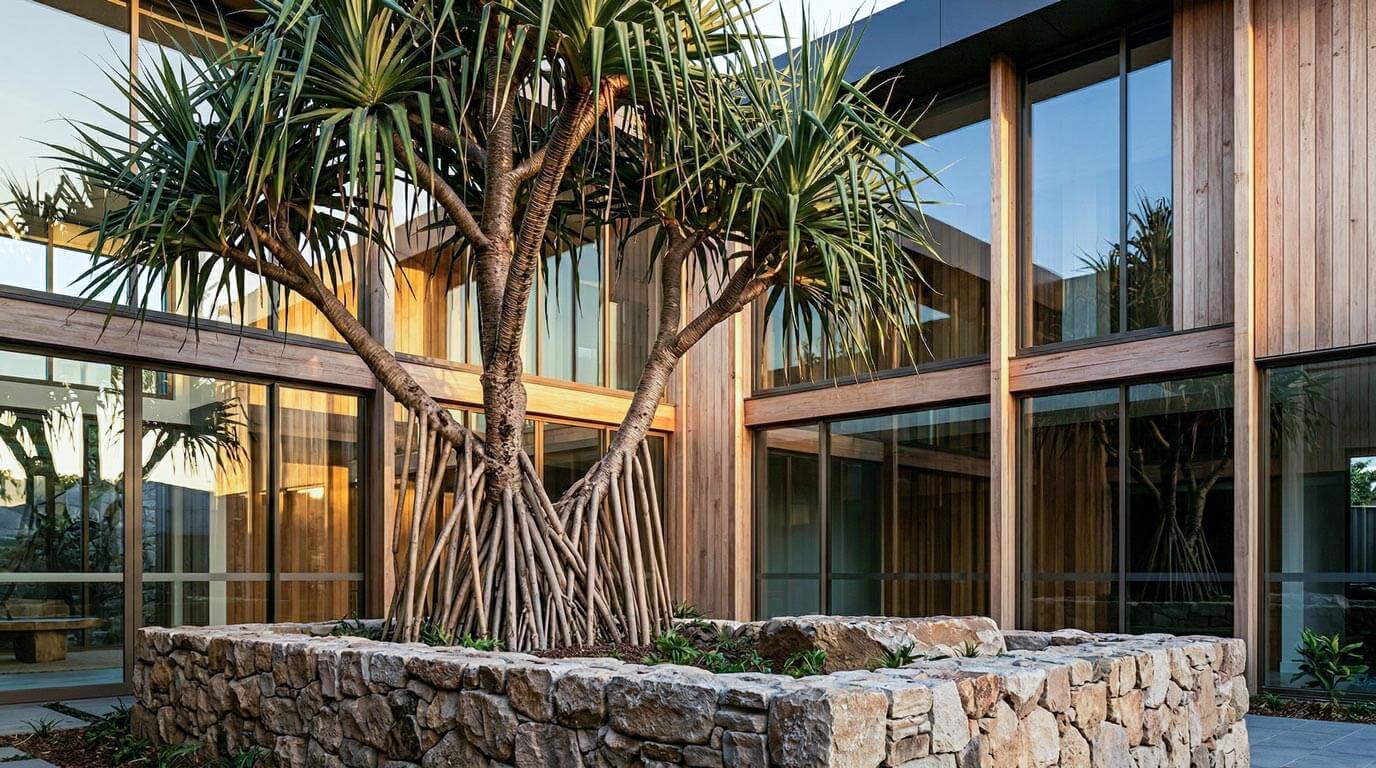 Species that hold their architectural shape against the strongest onshore gales, providing a structural anchor for the site.
Sculptural Toughness
In lean, sandy soils where nutrients are scarce and the wind is constant, form takes precedence over fragility. The sculptural toughness of Cycads, Agaves, and Pandanus hold their architectural shape against the strongest onshore gales, providing a structural anchor for the site.
Unlike a traditional garden that can look 'untidy' as it grows, a resilient coastal landscape looks better as it ages. The trunks of the Pandanus become more gnarly and character-filled; the Cycads become more imposing. The landscape settles into the site, becoming a permanent part of the home's architectural identity rather than a temporary cosmetic layer.
The Lean Landscape
True sustainability on the coast is an exercise in restraint. Permeable gravel beds and sandy substrates encourage deep root growth and natural drainage - essential during the heavy subtropical rains of a Queensland summer.
The goal is to move beyond the concept of a high-maintenance 'lawn and hedge' and toward a self-sustaining coastal ecosystem. In doing so, the home remains a place of repose, where the garden thrives on the salt air, and the architecture is softened by the very environment that once seemed so aggressive.
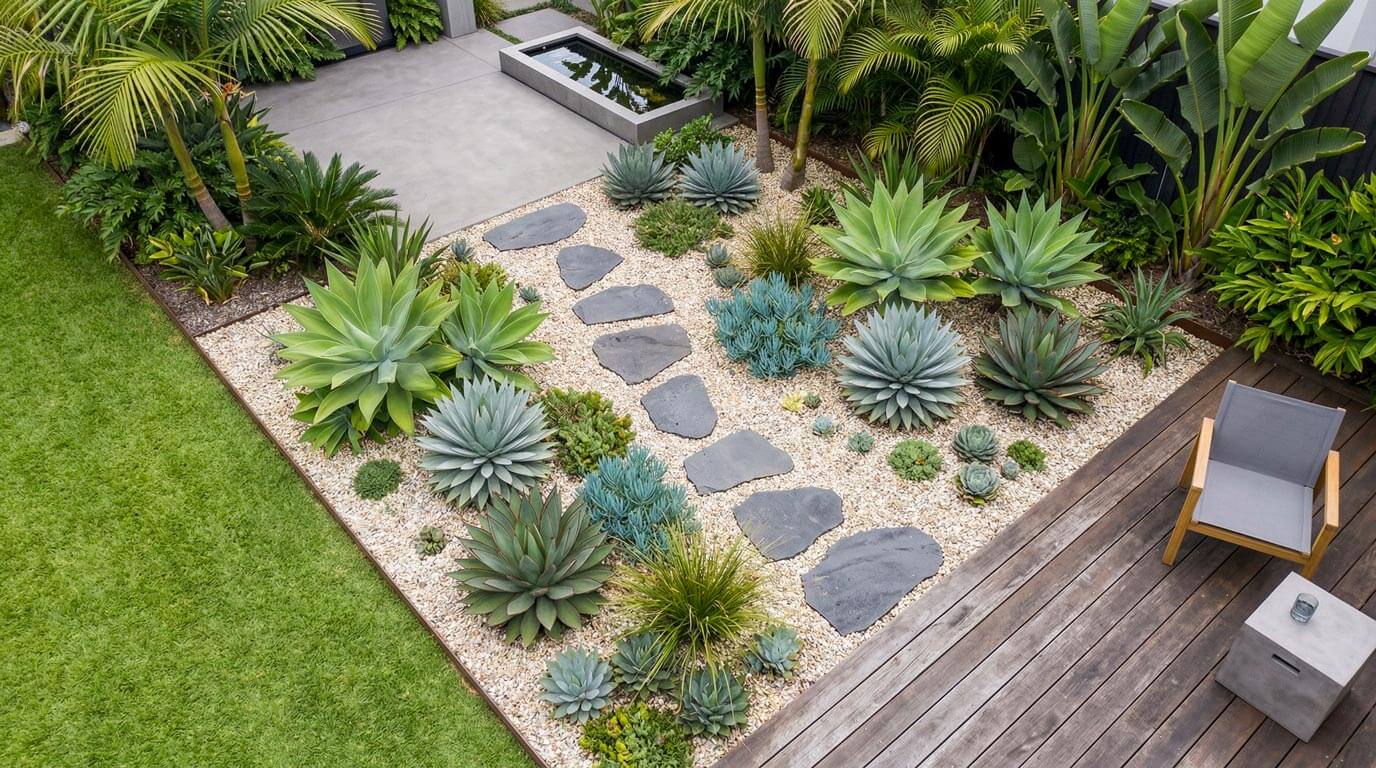 Moving beyond a high-maintenance 'lawn and hedge' and toward a self-sustaining coastal ecosystem.
Enduring Repose
A salt-hardened landscape shifts the focus from maintenance to longevity. By integrating species that thrive in the Pacific spray, the site matures into a self-sustaining ecosystem rather than a temporary layer. This approach yields a home of quiet ease, where the architecture remains a place of repose grounded in its natural context.


