
Project 05 · Residential · Studio project
The Stone House Sorrento
Material-Led Design for the Queensland Climate
For Sorrento · 2025
The design of The Stone House, Sorrento, is driven by a desire to connect indoor and outdoor living. Compartmentalised plans restrict natural light and prevent coastal cross-breezes from moving through the house. In this concept the thresholds between inside and out are deliberately blurred, so the home can be opened up to enjoy the Queensland climate.
 01 —Light timber joinery runs the full width of the kitchen, with a stone splashback and a window opening to planting at bench height.
Open-Plan Kitchen
Light timber cabinetry and pale stone benchtops carry the colours of the coast into the room, warm and sun-bleached rather than bright. The joinery runs the full width of the kitchen, with the ovens and refrigeration set into tall cabinets at either end.
A window sits between them at bench height, opening the kitchen to planting and daylight on a wall that would usually be solid. The greenery outside becomes the backdrop to the bench, and the light shifts across the timber through the day.
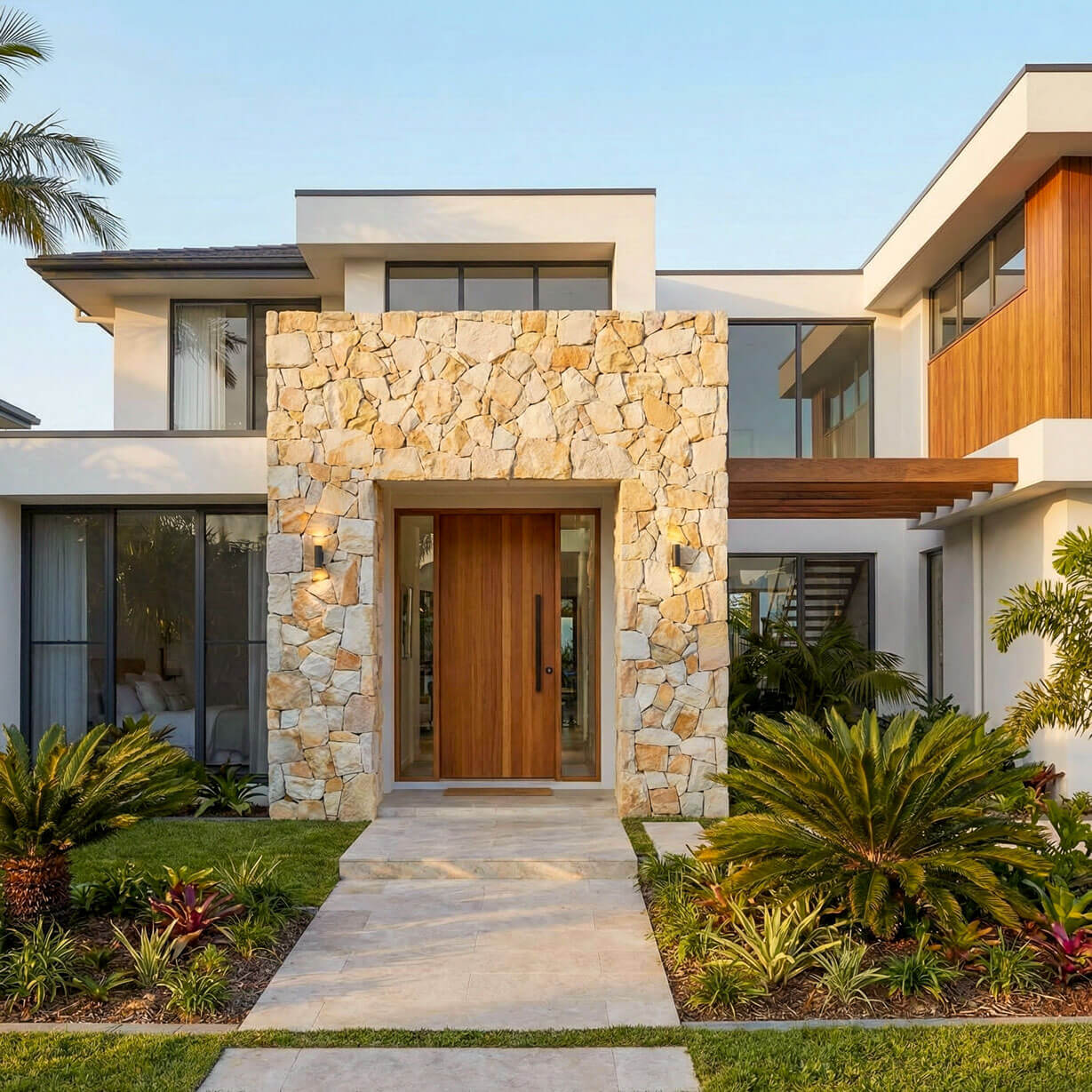 02 —Raw materials dictate a grounded approach to the home, where a heavy stone feature wall and warm timber elements establish the entrance.
Grounded Entry Sequence
First impressions for this Sorrento concept rely on robust materials rather than complex ornamentation. A heavy stone wall extends outwards from the rendered facade, framing the solid timber door set back within it.
This combination provides a distinct sense of privacy and permanence, establishing a clear transition from the streetscape to the private sanctuary within.
03 —Environmental context influences the front elevation, balancing privacy and openness through natural stone, timber battens, and clean white lines.Streetscape Presence
The front elevation addresses the necessary balance of privacy without sacrificing a connection to the outdoors. The integration of crisp white render against the tactile stone cladding and timber batten detailing creates a measured streetscape presence.
High-set glazing allows filtered light into the upper levels while shielding the interior living spaces from direct public view.
Dissolving Boundaries
The rear corner of the home opens completely. When the retractable glass doors slide away the structural corner disappears with them, and the living area extends directly onto the timber decking.
It is designed to adapt to the climate and to how the house is being used.
 04 —A seamless transition is created when corner sliding doors dissolve the boundary between internal living spaces and the outdoor pool deck.
 05 —A commitment to materiality reveals a substantial stone-clad volume, anchoring the rear structure and establishing a dedicated space for outdoor dining.
Outdoor Entertaining Zone
A robust outdoor kitchen and dining area is essential for year-round use in the Queensland climate. The rear elevation incorporates a substantial stone-clad pillar that visually grounds the two-storey structure while sheltering the space below.
The same stone appears here as at the entry, tying the rear of the house back to the front facade.
 06 —Cross-ventilation and natural light dictate the open-plan lounge, where fully retractable doors merge the interior with the timber decking.
Integrated Living Space
The main lounge opens to the pool and the waterfront beyond, with clerestory windows set high above the opening.
The track for the sliding doors is set flush with the floor, so the timber runs unbroken from the lounge out onto the deck. With the corner open, the room is covered but not closed, and the low sun reaches right across the floor, so it feels less like a room opening onto a deck than like sitting outside under cover.
The Sorrento Rear Profile
Seen as a whole, the rear elevation is where the concept resolves. White render, timber and stone are balanced across a facade that opens almost entirely to the north, and the pool and planting carry the living areas out to the boundary.
The house is designed to be used this way for most of the year, open at the back and shaded above, which on the Gold Coast is most of what a house needs to do.
 07 —Longevity and functional honesty are prioritised by a rear profile that completely opens to the pool and landscaped surroundings.
 08 —There is a palpable shift when the bedroom opens to the private balcony, connecting the inhabitant directly to the coastal climate.
Elevated Coastal Retreat
The bedroom is conceptualised as a secluded zone separated from the primary entertaining areas. This creates a calming environment, grounded by warm timber flooring and a custom timber bedhead.
By incorporating large sliding glass doors, the room expands outward onto a private balcony, maximising elevated views and inviting coastal cross-breezes deep into the space.
 09 —Sensory depth is achieved in the bathroom through tactile wall finishes and a floating timber vanity, offering a private retreat.
Tactile Bathroom Design
In the bathroom, the focus shifts toward providing a restorative experience. The design integrates a freestanding bathtub positioned to take advantage of natural light, while textured wall tiles add a subtle complexity to the room.
The choice of a floating timber vanity and brass tapware creates a functional yet highly refined space, prioritising daily comfort and spatial clarity.
Defining the Sub-Tropical Lifestyle
The Stone House, Sorrento, replaces restrictive, compartmentalised rooms with an open-plan layout that supports a sub-tropical lifestyle. The sturdy material palette and connection to the outdoors provide a home that adapts to both quiet living and extensive entertaining.
A site of your own?
Every project here began with the same questions: where does the sun come from, where does the water go, and what is worth keeping. If your site raises them too, that's the conversation to have.
Discuss your project