
 The Grain of the Drift. Meticulously aligned timber veneers create a tangible connection to the weathered patterns of coastal flora.
The Grain of the Drift
Textured cabinetry provides a tangible connection to the weathered patterns found in coastal flora. By prioritising the selection of refined timber veneers - where the ‘cathedral’ patterns and straight grains are meticulously aligned - a domestic comfort is achieved that feels both intentional and sophisticated.
The choice of a pre-finished surface allows for a consistency of colour and tone across large banks of joinery, mirroring the rhythmic repetition of the tides. Utilising a material that retains the warmth and biological resonance of the natural world involves a commitment to design integrity over transient aesthetic trends.
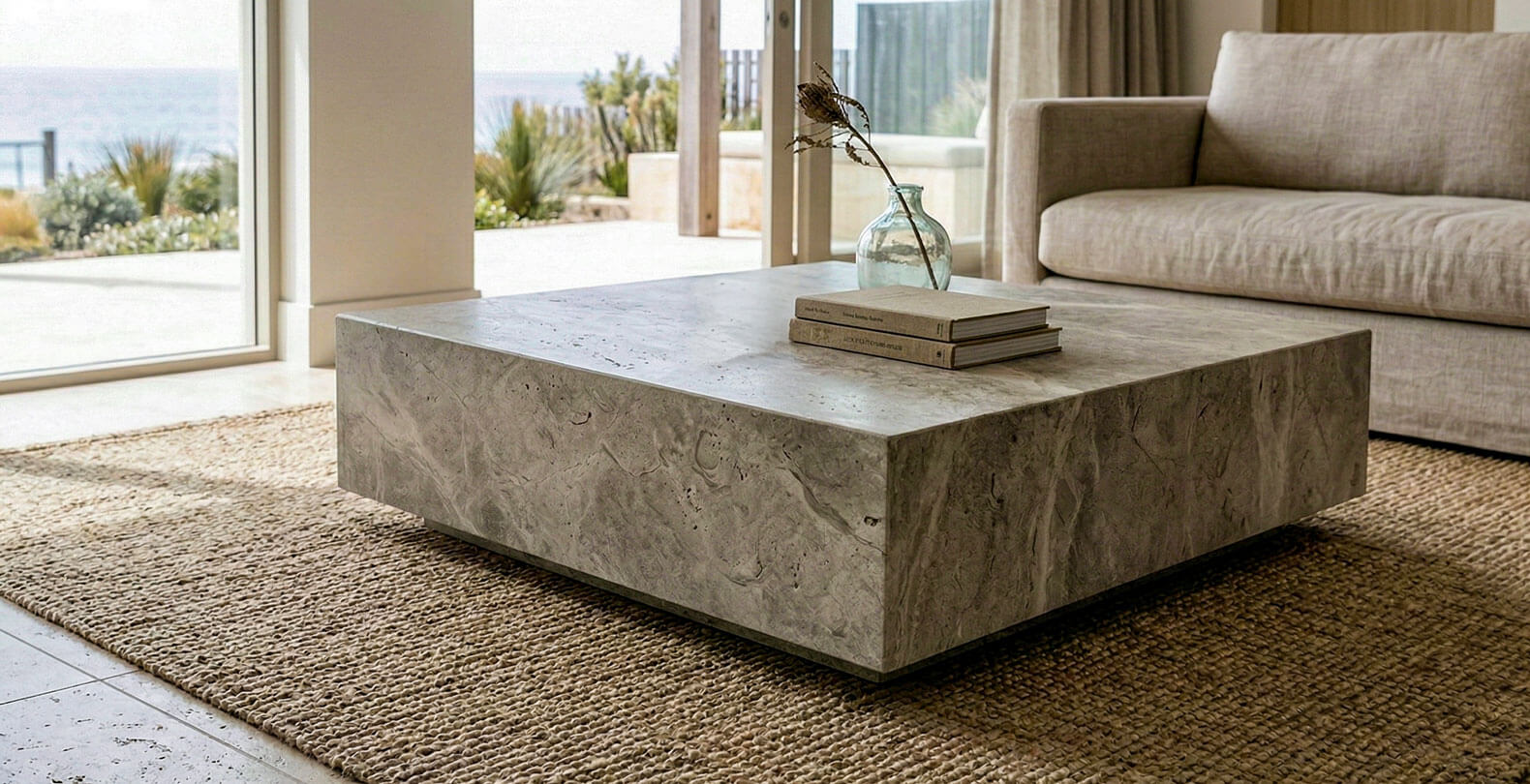 A monolithic plinth. This natural stone surface acts as a geological foundation, offering a cool tonal resonance within the retreat.
The Earth’s Weight
The selection of natural stone slabs, particularly those with a honed finish, acts as a monolithic plinth within the home. These surfaces reflect the ancient geological formations of the shoreline, offering a cooling biological benefit during humid seasons.
The visual complexity of the stone is a dialogue with the environment; as the light moves, it highlights the depth of the veining, while shifting coastal humidity subtly deepens the tonal resonance of the honed surface. It is an exercise in tactile veracity, where the material is allowed to be exactly what it is.
By defining a palette that reflects the essence of the shoreline, the architecture achieves a state of permanence - not by resisting the environment, but by allowing the context to complete the design.
 The living detail. Unlacquered brass records the environment through subtle oxidation, rejecting artificial newness for a lived-in resilience.
The Living Detail
In a coastal environment, the air itself becomes a design collaborator. Longevity is found in details that accept the environment, such as ‘living finishes’ in plumbing and hardware. Metals like unlacquered brass or organic bronze record the environment through subtle oxidation.
This rejection of permanent, artificial ‘newness’ suggests a home that is a living record of its site, where the marks of use and the touch of the hand are viewed as a natural evolution of the form rather than a flaw.
 The soft horizon. High-density linen provides the acoustic softening required to turn an open-plan space into a grounded retreat.
The Soft Horizon
The final layer of a grounded sanctuary is found in materials that mimic the coastal dunes. High-density linens and chunky wool weaves provide an element of acoustic and thermal softening required in open-plan living.
The irregular, organic weave of a textile caught in a sea breeze facilitates a visual movement that replicates the shifting sands of the foreshore, grounding the experience of the space through sensory touchpoints.
Resilience Through Material Sincerity
A home matures alongside the elements when it is built from a foundation of design integrity. By defining a palette that reflects the essence of the shoreline, the architecture achieves a state of permanence - not by resisting the environment, but by allowing the context to complete the design. This intentionality is felt in the quiet cooling of a stone plinth underfoot on a humid afternoon and the gentle, rhythmic rustle of linen in the breeze; a home that doesn't just occupy the coast, but breathes with it.


